Case study · Neto → Shopify migration
Bearings Express: off Maropost, onto Shopify, and running costs cut by almost two-thirds.
58,000+ historical orders, two eBay storefronts, a Bunnings channel, and 33,000+ vehicle-fitment links — moved with 15 minutes of downtime, no measurable dip in sales, and their monthly running cost cut by almost two-thirds.
58,000+
historical orders migrated — every customer account, 3,700+ SKUs
−63%
cut in monthly running cost — $1,534 down to $561 AUD
15 min
total downtime on cutover day
33,369
vehicle-fitment links live on eBay — up from 17,767 before the move
The client
Precision is the product.
Bearings Express is a Queensland-based specialist retailer of bearings, V-belts, mower parts and automotive components. Thousands of orders a month move through a catalogue where sizing is unforgiving: a bearing with a key measurement even 1 mm out may not fit at all — or fit incorrectly, move around and become damaged very quickly. Accurate sizing and vehicle-fitment data is the difference between a successful sale and the cost of a return and refund.
The business sells through its own website, two eBay storefronts and Bunnings Marketplace, all fulfilled from one warehouse.
The tipping point
Paying more every year, getting less.
Bearings Express ran on Neto for years, and it did the job. After Maropost acquired the platform, the equation changed: renewal pricing climbed sharply, while — in the team's experience — support that used to answer same-day started taking days.
The question wasn't whether to move — it was whether a move could be done without breaking a business that ships every day and can't pause for a "replatforming project".
Before / after
Same store. New platform.
The full homepage, before and after — the Neto site as it ran on Maropost, and the Shopify rebuild that replaced it.
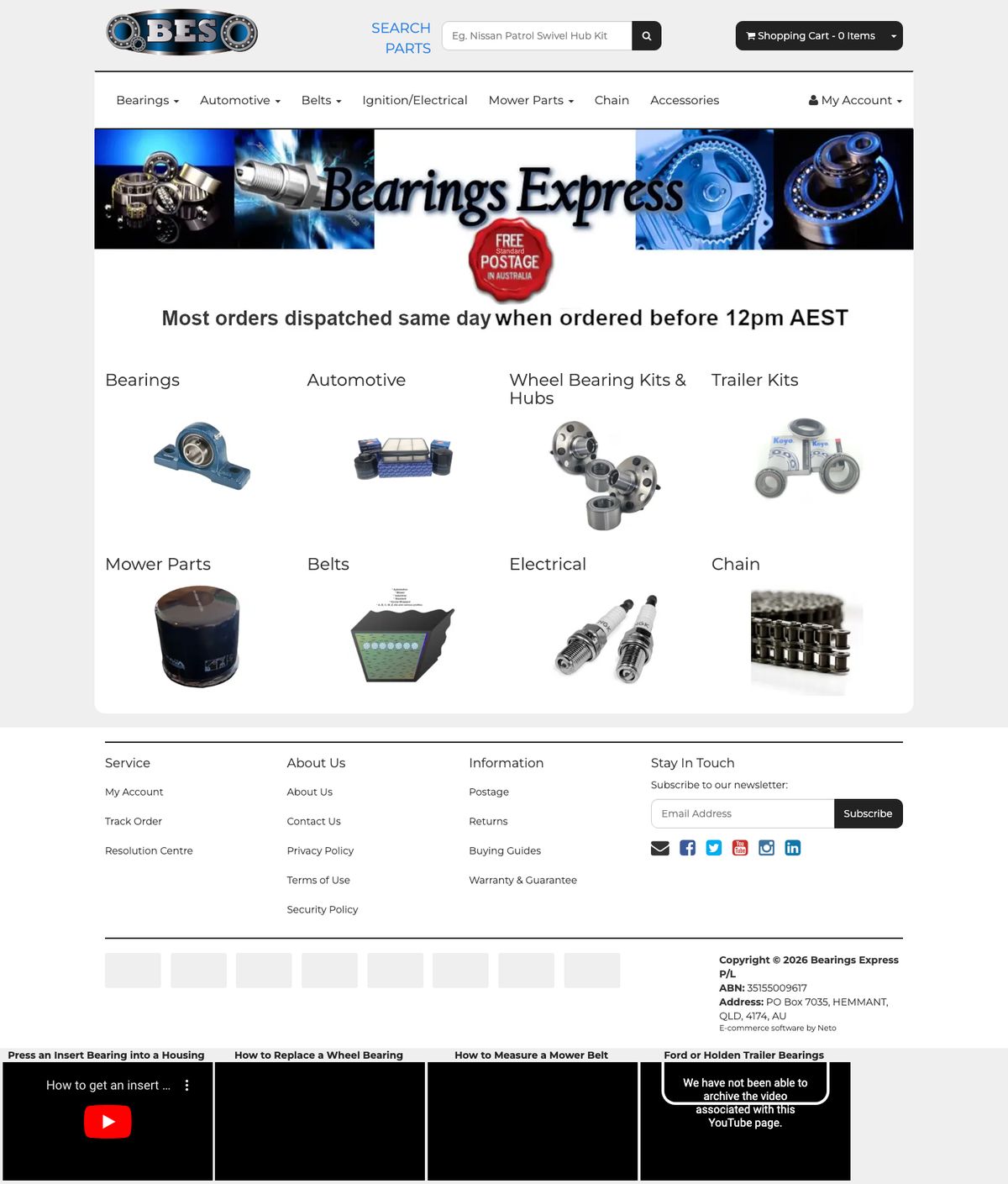
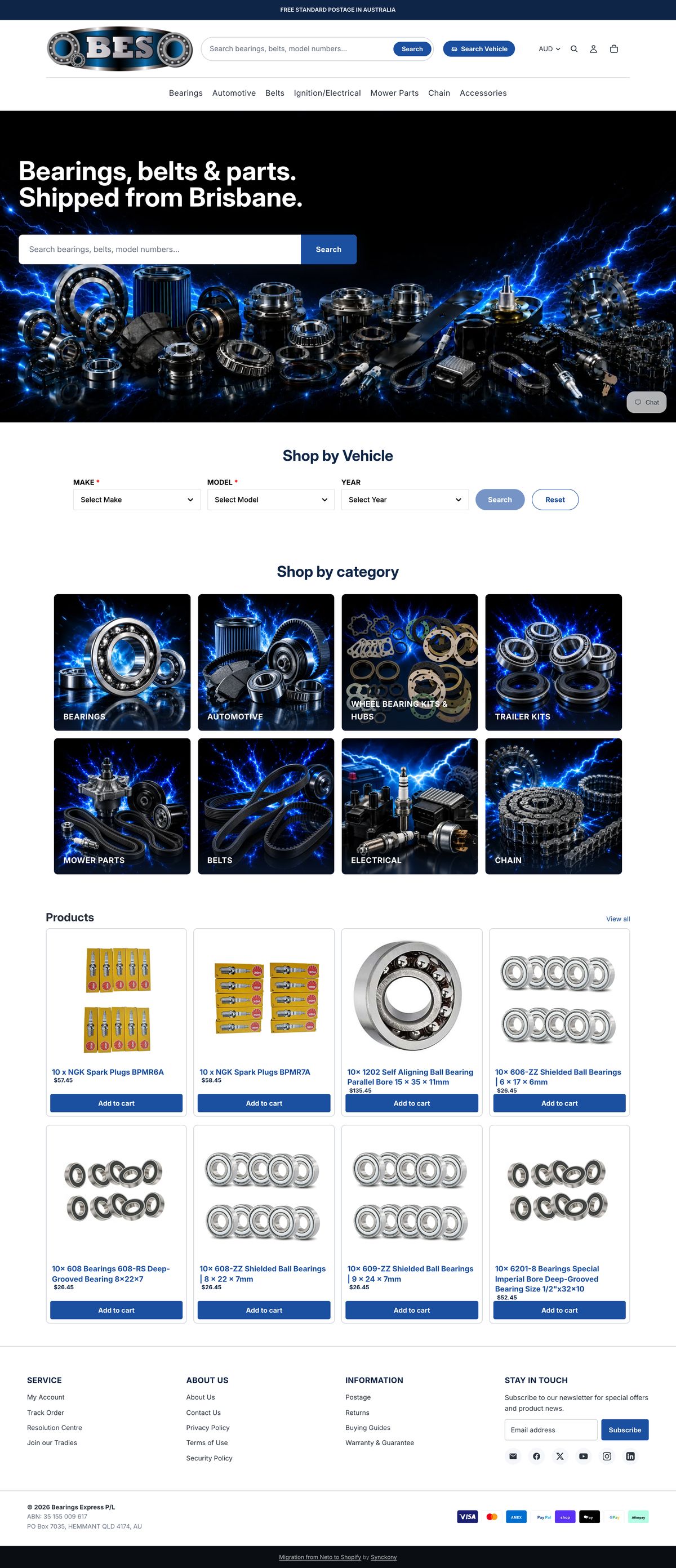
Full-page captures of each homepage, shown at the same scale. The Shopify page is simply longer — on-site vehicle search, category tiles, and a live product grid replaced the static category links.
Preparation
Measure everything before moving anything.
The discovery was free of charge. Before any commitment, Synckony audited the entire operation as it actually ran on Maropost: the full tech and marketing stack, 32 shipping methods and the logic that chose between them, the complete category tree, marketplace wiring for both eBay accounts and Bunnings — and the data quirks a migration would trip over, including the discovery that over half of the customer records carried eBay relay email addresses that would have poisoned any naive import.
Then the money question, line by line: every subscription, app fee and per-order cost on the old stack, mapped against its equivalent on the proposed Shopify stack — same capability or better on every row.
Monthly running cost, before and after
−63% · almost two-thirds offThat's $973.68 back every month — $11,684.16 a year — for the same capability or better on every line.
| Line item | Neto / Maropost | Shopify |
|---|---|---|
| Platform fee | $569.80 | $135.00 |
| Card transaction fees | $333.01 | $304.18 |
| Email marketing | $166.73 | $27.60 |
| Vehicle fitment app | $221.41 | $20.00 |
| Marketplace connectors | $217.80 | $47.73 |
| Shipping app | $0.00 | $26.22 |
| Social login | $16.67 | $0.00 |
| Hosting | $9.00 | $0.00 |
| Total | $1,534.41 | $560.73 |
All figures AUD per month, from the pre-migration cost audit. Pass-through lines that cost the same on both stacks (product feeds via FeedOps, address validation) are left out of the comparison.
The build
Everything moved. Several things improved.
Every record, not a sample
All 58,000+ historical orders were imported with their original order numbers and dates, searchable exactly as before, and every customer account came across. Crucially, it wasn't just the headline fields: every single field on every record made the trip, so future segmentation — by product bought, spend, recency or channel — works on complete data from day one. Shipping addresses were backfilled onto more than 50,000 historical orders.
The catalogue, restructured where it deserved it
All 3,700+ SKUs came across — translated, not copy-pasted. Neto structures a catalogue as parent items with child items inside a nested category tree; Shopify thinks in variant-based products and flat collections. The migration mapped one model onto the other: 48 parent/child families — 1,247 child SKUs of belts and bearings — became true size-variant products, one page and one size picker per family, and the category tree was rebuilt as flat, navigable collections.
Shipping logic recreated exactly
Bearings Express's satchel-versus-eParcel logic is their secret formula — tuned over years to pick the smartest, cheapest way to ship every parcel from its product size, weight and destination postcode. That formula, a five-thousand-postcode rule set, was recreated on Shopify to the letter, so every order keeps the shipping savings — plus automatic warehouse pick-tags on every incoming order.
B2B trade pricing, rebuilt end to end
Tradies get their own prices at Bearings Express, and the whole pipeline came across: the trade-application form on the site, approved accounts managed as proper companies in the Shopify admin (39 of them), and 3,019 per-SKU trade prices — carried over from Neto's customer price groups — applied automatically at checkout whenever a trade customer signs in.
Standing offers and policies, preserved
The offers customers already knew kept working through the move. Buy-in-bulk pricing — 2.5% off at two items, 5% at three, 7.5% at four or more — applies automatically at checkout, with trade accounts excluded so the two discounts never stack. And the coupon codes sent out through their email marketing campaigns were re-created, so nothing a customer was holding stopped working overnight.
Marketplaces: reconnected and made better
Both eBay storefronts reconnected with listings and the item-specifics that drive eBay search placement intact — and the data came out better than it went in. Vehicle-fitment coverage grew from 17,767 compatibility links across 180 products before the migration to 33,369 links across 254 products after, refreshed automatically every week. Bunnings improved the same way: the legacy feed only ever got 194 of its ~390 products through validation; the rebuilt Marketplace mapping publishes 216 cleanly and picks up newly barcoded products automatically. And the move opened a new channel on Temu.
The website came out ahead
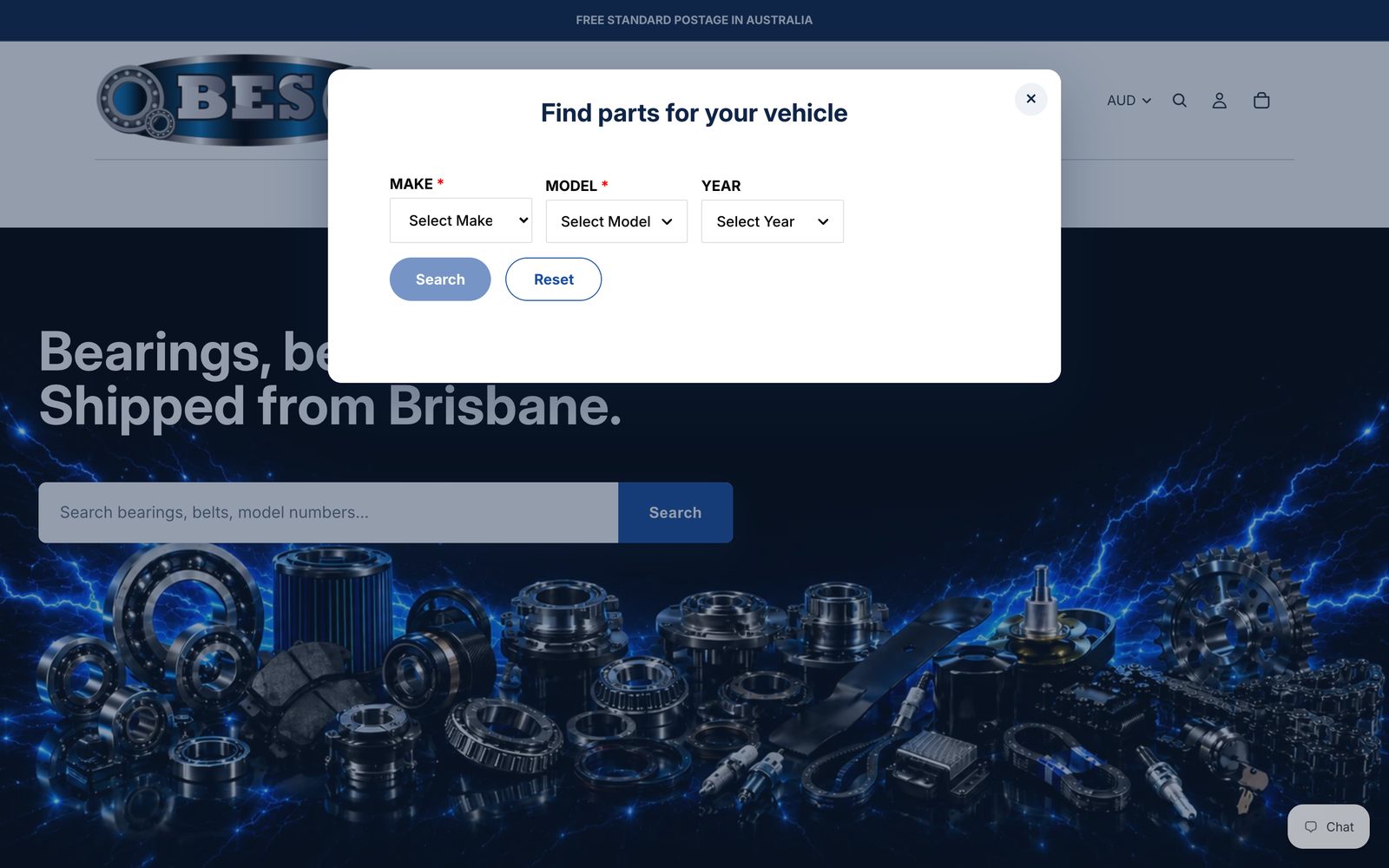
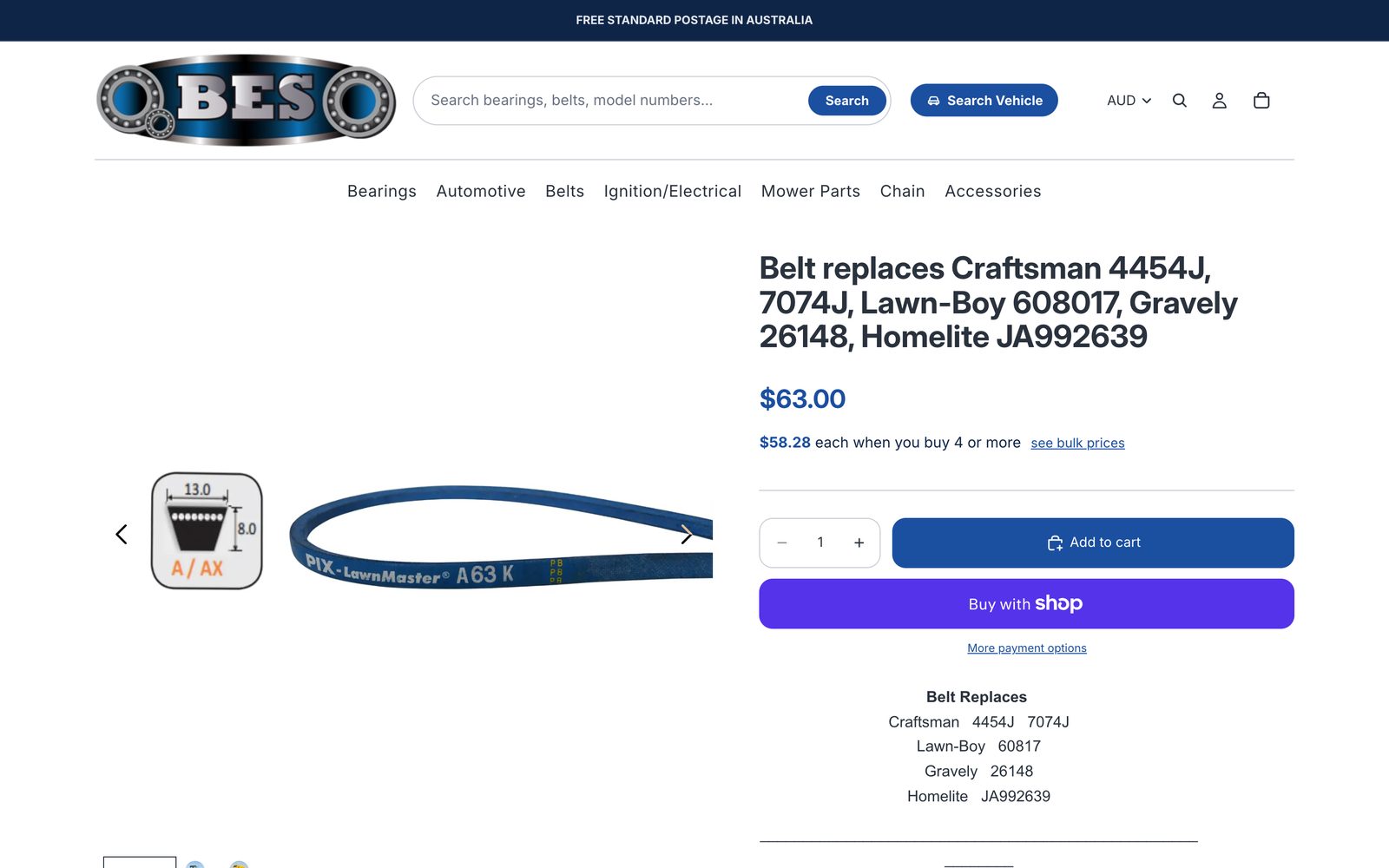
A refreshed design; on-site vehicle search (year / make / model); belt size guides on the product page and inside eBay descriptions, driven from one data source so they can never disagree; bulk-pricing offers next to the price; and interchange part numbers made searchable.
Migration day
Fifteen minutes.
The riskiest moment of any replatforming is DNS cutover. The incumbent DNS host's configuration would have forced a two-to-four-hour propagation blackout, so DNS was moved to Cloudflare ahead of time — making the final switch a staged, pre-verified flip rather than a leap of faith.
The same care went into traffic: 1,922 URL redirects — built from Google Analytics and Search Console data to cover the store's most-visited pages, every product and every buying guide — were imported before the switch, so old Neto URLs land on their new Shopify homes instead of 404s and hard-won search rankings carried straight over.
Total downtime on the day: 15 minutes. Orders flowed before, and orders flowed after. Sales through cutover week tracked normal — no dip, no recovery period, no "please bear with us" banner.
And the month after was included, not invoiced: a written operations guide, screen-share training, and same-week turnaround on every "how do I…" — while the weekly fitment refresh, marketplace syncs and pick-tag automation run unattended.
Monthly running cost
$1,534.41
$560.73 — almost two-thirds lower
Historical data
On the old platform
All orders + customers migrated, searchable
eBay vehicle compatibility
17,767 links across 180 products
33,369 links across 254 products, auto-refreshed weekly
Vehicle search on site
✗
✓
Marketplaces
Website, eBay ×2, Bunnings
Same, plus Temu
Shipping logic
32 methods, satchel/eParcel split
Recreated exactly, plus automated pick-tags
Trade (B2B) pricing
Neto customer price groups
39 companies, 3,019 trade prices, automatic at checkout
Support
Days, in the team's experience
A partner on first-name terms
Thinking about leaving Maropost?
Synckony has been on both sides of this migration — deep in Neto's data model and fluent in Shopify. The discovery and cost comparison are free, and you'll know your real before/after numbers before you commit to anything.
Your store could be next.
A free audit, a fixed quote, and a cutover measured in minutes — not days.